Somebody posts a raw card in the group. "Should I grade this?" Forty comments. Nobody runs a single number.
Here is the number-running. All prices pulled early July 2026 from sold-comp trackers and PSA's own site. Where a figure is thin we say so, because that is how we do things around here.
What grading actually costs right now
PSA's cheap tiers are paused. As we covered in this week's column, the backlog hit roughly 12 million cards, and until it clears, the cheapest door that is actually open is Regular: $79.99 per card, 40 to 50 business days, $1,500 max insured value.
Add the rest of the trip: postage to PSA (which does not insure your inbound package, read that twice), return postage billed at checkout, a Card Saver, a sleeve. All in, one card through the Regular tier runs roughly $105 to $130. If the Value tier reopens and you batch five cards, call it $40 to $45 per card. We will use $110 as the working number for one card today.
So the question is never "is my card nice." The question is: will the graded price exceed the raw price by more than about $110, times the odds of actually getting the grade?
The odds part everyone skips
PSA's gem rate ran about 43 percent in the first half of 2025 per GemRate data. Less than half of everything submitted comes back a 10, and that number is inflated by professionals who pre-screen ruthlessly before submitting. The all-grader sports rate was 34 percent.
And the average hides the pain. Set-level data reported from GemRate shows hot rookies gemming far below their set average, in one reported case under 10 percent while the set around it gemmed near 50. The exact card everyone wants to grade is the card the whole hobby is grading, and the standards do not loosen for demand. Your "clean" card is a coin flip at best, and if you have not run the self-grading routine, it is worse than a coin flip.
Three real cards, three verdicts
The $60 card: 2023 Prizm C.J. Stroud Silver. Raw sells around $63. PSA 9 around $75. PSA 10 around $359. Run it: a 10 gains you about $296 over raw, minus $110 of fees, so plus $186. A 9 gains you $12 and costs $110, so minus $98. At a 43 percent gem rate the expected value is barely positive, and that assumes pro-level pre-screening odds. If your true gem odds are the hobby average or worse, this card is a losing ticket. Same shape on a Wembanyama base: raw $67, PSA 9 $100, PSA 10 $339.
The $15 card: a 2023 Bowman Chrome Elly De La Cruz refractor. Raw copies sell around $15. One recent PSA 9 sale we found closed at $11.51. Read that again: the graded card sold for less than raw. One sale, thin data, but it is the whole article in one line. You can pay $110 to make a $15 card worth $11.
The $700 card: 2023 Bowman Draft Paul Skenes auto. Raw around $700. PSA 9 around $760. PSA 10 around $2,450. Here the math finally works: the 10 pays about $1,640 after fees, and even the 9 roughly covers its costs. This is the tier where grading is a real strategy instead of a lottery ticket, which is exactly why every card over $500 in our shop conversation starts with "slabs only."
Where the line sits
Put it together and the rule is blunt. At today's $110 all-in cost:
A card whose PSA 10 price is under about $150 should basically never be submitted. Even a guaranteed gem barely pays, and nothing is guaranteed.
Between $150 and $400 at the 10, you are betting on your own pre-grading honesty. The 9 must not kill you. On the Stroud, the 9 loses $98. If you cannot look at your card under one hard light and honestly call it a 10, the market is telling you to sell it raw.
Above roughly $1,000 at the 10, grade it. The 10 pays huge and the 9 usually floats the fees.
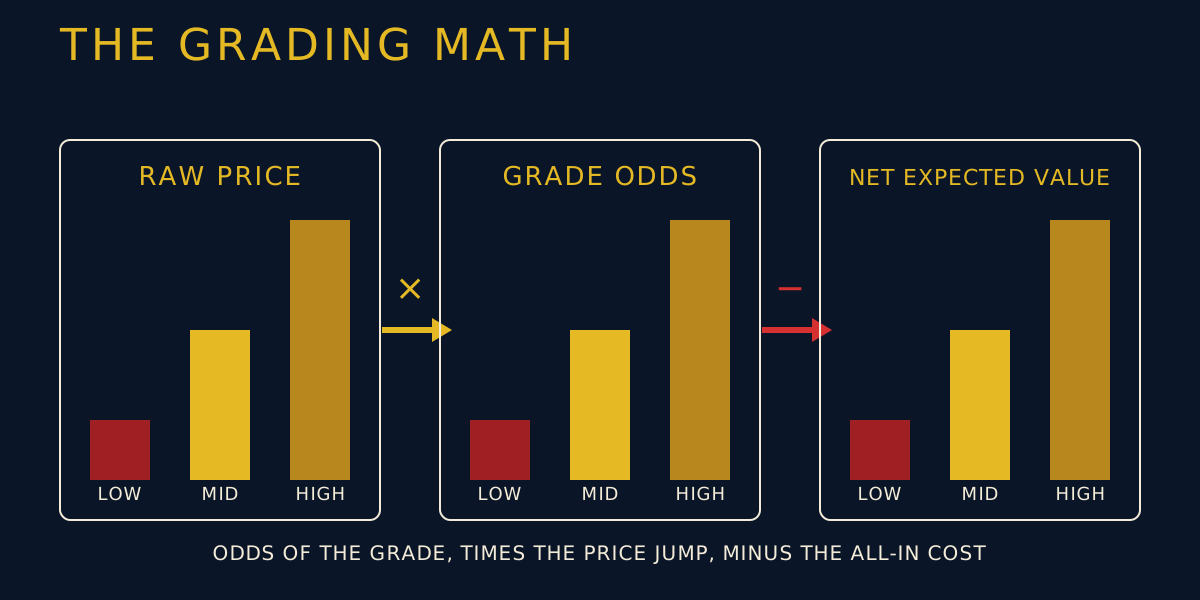
And if the Value tier reopens at $33, the line drops with it. The math is a formula, not a commandment: odds of the grade, times the price jump, minus the all-in cost. Run it every time.
The part nobody wants to hear
Most cards people post in groups are Band 1 and Band 2 cards with Band 3 dreams. The slab does not add value. It reveals it, charges you $110 for the reveal, and as we wrote at length, the reveal is partly an opinion. Our shop prices raw cards on honest condition notes precisely because we would rather tell you what the card is than charge you to find out.
Numbers move. Fees change, comps drift, tiers reopen. The formula does not. Run the math before you mail the card, and if the math says no, that is not bad news. That is $110 still in your pocket.