
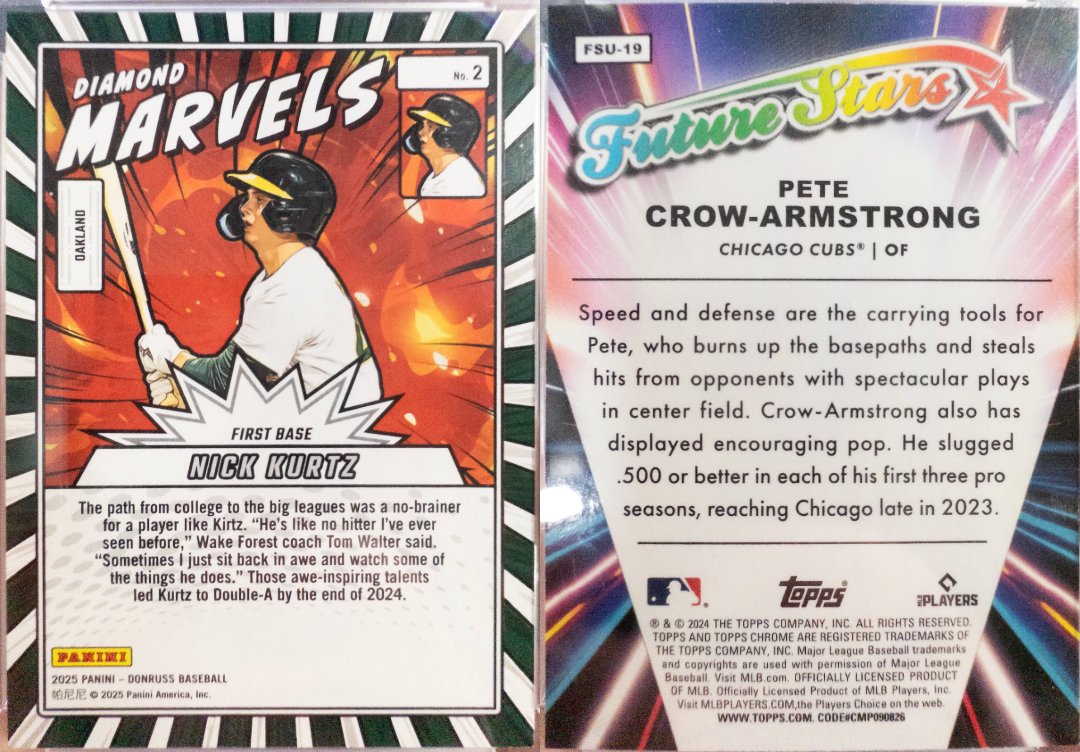
There are two cards on my desk right now.

One is a 2024 Topps Chrome Update Pete Crow-Armstrong Future Stars rookie. Clean surface, sharp presentation, the kind of card you pull and immediately sleeve. PSA graded it a 6.
The other is a 2025 Donruss Nick Kurtz Diamond Marvels. To my eye it shows more wear than the Crow-Armstrong, not less. PSA graded it a 7.
Worse-looking card, higher grade. Same company, same scale, same grading ruleset.
Now, a fair reader will stop me here and say: "That is just your read. You are eyeballing it." Exactly. That is the entire point. Two reasonable people can look at the same two cards and rank them in opposite order, and the number on the slab is just one more opinion in that pile. We have built a multi-billion dollar market on the premise that the number is something more than an opinion. It is worth asking whether that premise is actually true.
The leader of the industry says the quiet part out loud
This is not a fringe accusation. It is in PSA's own published grading standards.
"the other component of grading is somewhat subjective"
PSA states plainly that while a large part of grading is objective, there is a subjective element around a question of what the market will accept for a particular card (psacard.com/gradingstandards).
Read that again. The most trusted name in the hobby tells you, in writing, that part of the grade is a judgment call. Not a measurement. A judgment.
A real standard does not work that way. A caliper does not return a different reading depending on who is holding it or what kind of week they are having. When the definition of the standard contains the word "subjective," it is not a standard. It is an expert opinion wearing the costume of one.
The resubmission lottery
If grading were strict compliance to a fixed rule set, the same card would receive the same grade every time. It does not.
Collectors have documented this for years. The same card, cracked out of its holder and resubmitted, comes back a different number. Sometimes higher, sometimes lower, sometimes flagged with a defect it did not carry the first time. Threads full of these stories describe the process, accurately, as a lottery (Collectors Universe forums). Cards returned as "miscut" that line up perfectly with raw copies. Grades that move a full point on a second look at the identical piece of cardboard.
You cannot have it both ways. If the card did not change, and the grade did, then the grade was never a property of the card. It was a property of the grader on that day. That is the definition of subjectivity, and it is baked into the output.
The incentive structure nobody designed on purpose
Here is where it gets uncomfortable, and I want to be careful and fair about it.
PSA uses a declared-value system. You estimate what your card will be worth after grading and submit it under a service tier, and every tier carries a max insured value. If PSA determines after grading that your card's value exceeds your tier's cap, PSA upgrades the service level for that card and you pay the additional fees before it comes back to you (psacard.com/info/max-insured-value). PSA itself assesses that post-grade market value.
PSA's stated reason is insurance and handling. A higher-value card carries more liability, so it costs more to process. That explanation is reasonable on its own terms, and PSA is explicit that the grade is finalized before any value assessment happens.
But step back and look at the shape of it. The company that assigns the grade is the same company that then values the graded card, and a higher grade produces a higher value, which produces a higher fee. The grading authority and the direct financial beneficiary of a higher grade live under one roof. Even if every grader is acting in perfect good faith, that is a structural conflict of interest the hobby has simply normalized.
It has not gone unnoticed. Through late 2025, dealers publicly halted PSA submissions amid a dispute over a buyback program, with critics pointing to PSA's dual role as both the arbiter of grades and a participant in the market those grades define, alongside opaque standards that offer no detailed explanation for why a given card scored the way it did (Slab-Z coverage). Layer on two price increases in the span of twelve months and paused service tiers (Pre Grade Cards), and the picture is of a system that asks for more trust and more money while explaining itself less.
What objective grading actually looks like
The usual defense of human grading is that there is no real alternative. That defense expired.
AGS (Automated Grading Systems) grades with a fully automated pipeline. Cards are run through 3D laser scanners that capture on the order of tens of millions of data points per card, detecting centering, corners, edges, and surface flaws down to microscopic scratches and print lines that human graders routinely miss. The company was founded in 2021 specifically to address inconsistent results and human bias, and it returns the same grade on the same card every time, with no fatigue and no value-based upcharge (agscard.com).
TAG (Technical Authentication and Grading) uses patented photometric stereoscopic imaging and grades on a 1000-point scale. Every TAG card arrives with a Digital Imaging and Grading report you scan with your phone to see every identified defect, the scoring breakdown for each attribute, and the population data. Their stated goal is to represent the objective standard for grading (taggrading.com).
Notice what both of these do that PSA does not. They show their work. You do not get a bare number and a shrug. You get the measurements, the flaws, the imaging, the math. AI prediction tools already hit accuracy within one grade point in the vast majority of cases and improve as more data flows in (CardGrade). The technology is not a someday. It is available now, and demand for it is climbing fast.
Is machine grading flawless? No. Algorithms can be wrong, and some operations still apply human review. But "consistent and auditable, occasionally wrong in a way you can inspect" is a categorically better standard than "inconsistent and opaque, wrong in a way no one will explain to you."
The honest counterargument
The strongest objection to everything above is simple: PSA slabs sell for more. PSA graded roughly 8.89 million cards in the first half of 2025 and remains the market leader, with its grades commanding the highest resale premiums in the hobby (CardGrade). If the market rewards PSA, who am I to argue the market is wrong?
But look closely at what that premium actually measures. It does not measure grading accuracy. It measures brand recognition and liquidity, the confidence that the next buyer will also accept the label. That premium is not evidence the grade is correct. It is evidence that we have all agreed to act as if it is.
And that is the most important thing to understand here. PSA slabs sell for more because consumers allow them to. The premium is a choice the market keeps making, not a law of nature. Brand inertia holds exactly as long as buyers keep paying into it, and not one day longer.
What I am actually asking
I am not telling you to crack your PSA slabs or to torch the company. I am asking for something smaller and more honest.
Stop treating the resale premium as proof of accuracy. It is proof of habit.
Stop discounting the grade of a company that hands you a forensic report over the grade of a company that hands you a number and a subjective definition.
And the next time you decide where your money goes, remember that you are not just paying for a grade. You are voting for a standard. A system that admits in its own documentation that the grade is partly an opinion, that returns different numbers on the same card, and that profits more when it grades higher, is not the standard this hobby deserves. We have better tools now.
The only thing keeping the old system on top is our collective decision to keep funding it.
That decision is reversible. It starts the moment enough of us stop making it.
Disclosure: I am not affiliated with TAG, PSA, AGS, or any other grading company. I hold no position in and receive no compensation from any grader named or referenced in this piece. These are my own observations as a collector.
Originally published as an article on X.