
Every set builder knows the feeling. You are cruising. Lot after lot, ninety cards land for the price of a pizza, and the binder is filling up fast. Then you hit the last stretch and the whole thing stalls out. Same twelve cards, week after week, and every listing you find wants triple what the rest of the set cost per card.
That is not bad luck. That is just how set building works, and once you understand why, you stop fighting it and start budgeting for it.
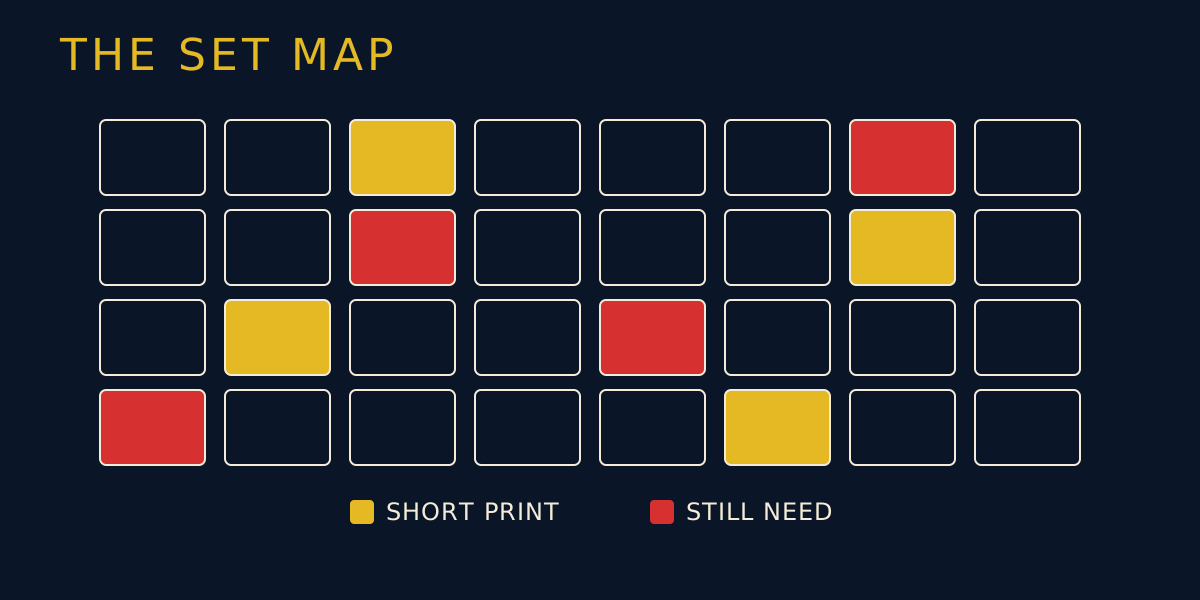
Why the last 10% costs half the money
A set has commons and it has the handful of cards everybody wants. Rated rookies, short prints, the two or three names that carried the whole product. Every single person building that set needs those same cards, and supply for them was never as deep as the commons to begin with.
So picture the math. Ninety cards in a set might run you sixty bucks total if you buy smart. The last ten cards, the short prints and the star power, can easily run another sixty on their own. Not because they are rare in some magical sense. Because demand for those specific cards is universal and demand for a random common is close to zero.
Once you see that split, you stop being surprised by it. You budget for a cheap 90% and a real number for the hard 10%, and you stop treating the last dozen cards like a rounding error.
Lot or singles: pick one on purpose
There are two ways to build a set and most people accidentally do both at once, which is the expensive way.
Buy a lot, then hunt. Find a seller offering seventy percent of the set as one bulk lot. You are paying pennies per card because the seller does not want to list ninety individual auctions any more than you want to bid on them. This gets you the bulk of the set fast and cheap, and it leaves you with a real needs list instead of a guess.
Buy singles from the start. Some builders prefer this because they want control over centering and condition on every card. Fine, but know what you are signing up for. Singles cost more per card even on commons, because you are paying for someone to list, photograph, and mail one card at a time.
The mistake is starting with a lot, then also individually buying singles of cards you already own because a good deal popped up before you checked your list. That is how people end up with three copies of a card worth forty cents. Pick your lane before you start bidding.
The doubles trap
This one is sneaky. You are hunting for six cards left in your set. A cheap lot comes up with four of them mixed in with thirty other cards you already have. You do the math on cost per card and it looks like a steal, so you buy it.
Except now you own thirty-four cards you did not need, twenty-eight of which are commons you already had two copies of. You did not get a deal. You paid singles-adjacent prices for a stack of duplicates that do nothing for your set and are worth close to nothing to anyone else either.
Lots are great when they are net-new. They are a trap when you are buying them to backfill a short list, because the math that made the lot cheap assumed you wanted all of it, not four cards out of thirty.
Track the list, not your memory
You do not need a spreadsheet with color coding and formulas to track a set. You need a list of card numbers, and you need to actually check it before you buy.
A note on your phone works. So does a sheet of paper folded into your binder. Write the set name at the top, list every card number, and cross off what you own as it lands. When you are looking at a lot or a listing, open the list, check the numbers against what is offered, and only bid on what is still open.
The reason this matters is not organization for its own sake. It is that memory lies. You will swear you still need card 88 because you remember pulling it a while back, except that was a different set from three years ago. A number on a list does not have that problem.
Set a ceiling and do not move it
Before you start hunting the hard cards, decide what you are willing to pay per card and write that number down too. Not a vibe, an actual number.
The short print chase is exactly where builders blow their budget, because after losing four auctions in a row on the same card, the fifth one starts to feel worth any price just to be done with it. That feeling is the whole trap. The card is not worth more because you are tired of chasing it. Set the ceiling before the frustration sets in, not during the bidding war when you are three coffees deep and refreshing a listing.
If a card keeps coming in over your ceiling, that is information, not a reason to raise the number. It means that card is genuinely scarcer or more in-demand than you assumed, and the fix is patience, not a bigger budget.
Trade the duplicates instead of selling them
Extra copies of commons are basically worthless to sell. The listing fee and the postage cost more than the card, and you will spend more time packing a two dollar card than it is worth.
But those same duplicates are gold to someone else's needs list. If you run in any kind of collector group or know other builders working the same or similar sets, trade duplicates directly. No fees, no postage cost eating the value, and you clear space in your own boxes while helping someone else close out their list. Selling makes sense for genuinely valuable extras. For commons, trade first and only sell what nobody wants.
When to just hand off the annoying part
Here is the honest version of all of this. Building the first 90% of a set is genuinely fun. It is cheap, it moves fast, and every lot that lands feels like progress.
The last dozen cards are a different kind of task. It is repetitive searching, checking the same few numbers against listing after listing, waiting out auctions on cards you already know you need, and doing math on whether a lot is actually a deal or a doubles trap in disguise. That part is not fun. It is just work, and it is the part builders actually quit sets over.
That is the exact gap our Complete Your Set service fills. Send us the list of what you still need. We give you one number for the whole remaining list, source the cards, and mail out the box. No auction-refreshing, no doubles trap, no losing three coffees worth of afternoon to card 141. You get the finished set. We eat the annoying part.
Send the list, get the number, get the box. That is the whole pitch.