
You are scrolling a group at eleven at night. Somebody posts a raw rookie, four photos, a price, and a "first come first served." The photos look clean. The corners look sharp. You send the money and three days later a card shows up with a corner ding nobody mentioned and a surface that looks like it went through a car wash.
This happens every single day, and it is almost never a scam in the legal sense. Nobody stole your money. They just showed you a photo instead of a card, and a photo lies by omission better than any seller ever could. Here is how to read the picture before you pay for it.
A photo lies by omission better than any seller ever could.
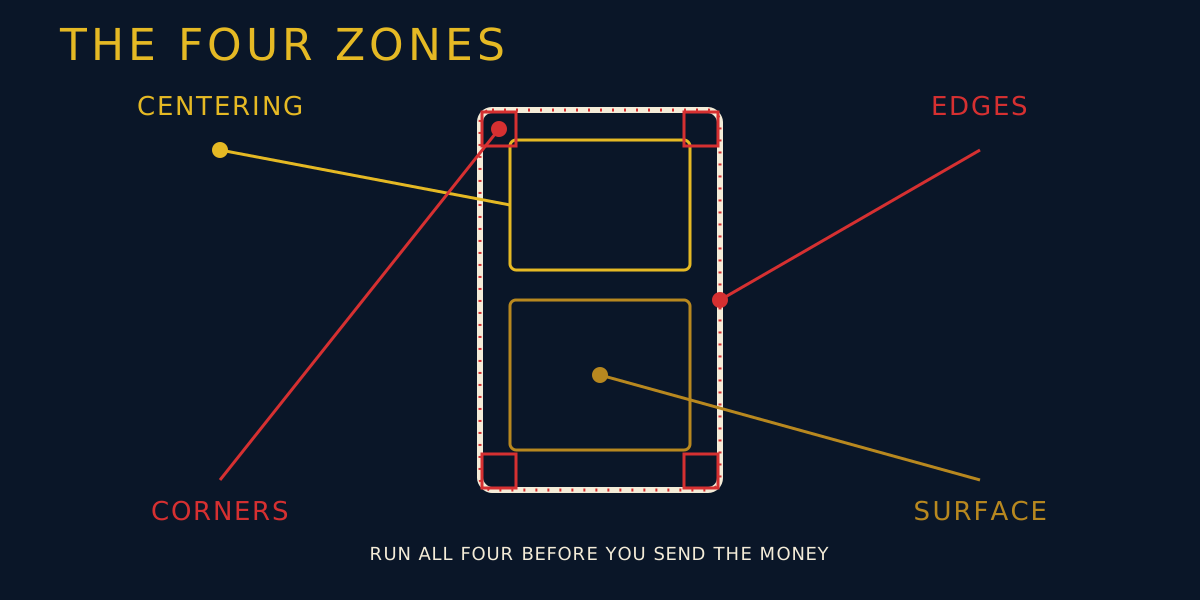
What glare hides
Ring lights sell cards. They also erase them.
A hard, even light bouncing straight off a card surface washes out exactly the stuff you need to see: scuffs, print lines, hairline scratches, the dull patches where a card got rubbed against a sleeve for six months. Glare flattens texture into a single bright sheet. That is great for making a card look new. It is terrible for you, the buyer, trying to figure out if it actually is.
A card with real surface wear can look like a gem under a ring light held at the right angle. The seller may not even know they are hiding anything. They just took the photo that looked best. Your job is to not accept that photo as the whole truth.
The angles sellers avoid
Watch what is missing, not just what is shown.
Most listing photos are the front, dead center, straight on. That angle is the most flattering one on the card and the least useful one for you. It shows off the picture and buries almost everything else.
The back corners are the tell. Sellers photograph the front corners because that is where the eye goes first, and they often skip the back entirely, especially the two corners near the bottom where a card gets picked up and set down a thousand times. If a listing has four photos and none of them are the back corners up close, that is a gap, and gaps are where problems live.
Same story with edges on a dark border. A black-bordered card or a dark uniform running along the edge will camouflage whitening and edge wear better than almost anything else in the hobby. A chipped edge on a white border screams at you. That same chip on a navy border practically disappears in a five-inch phone photo. If the card has dark borders and the seller only shows the front, you are flying blind on the thing dark borders are built to hide.
Four photos, all shot from the front, zero of the back corners: that is not proof nothing is wrong. That is just where the camera pointed.
The questions that flush out problems
You do not need to accuse anyone of anything. You just need to ask for information the seller has not volunteered yet.
"Can you tilt it under one light and video it for a few seconds?" This is the single best question in the hobby. A phone video under one moving light source catches surface flaws a still photo never will, because scratches and print lines only show up when the light rakes across them at an angle. A seller with nothing to hide will do this in thirty seconds. A seller who stalls or sends the same four static photos again is telling you something.
"Can you show me the back corners close up, in focus?" Ask for it specifically. Not "more pics," which invites another glamour shot of the front. Ask for the exact thing the first batch of photos skipped.
"Any creases, dents, or soft corners you can feel with your fingers?" Some damage does not photograph at all. A soft corner from a pocket, a crease that only shows when you flex the card slightly, these live in touch, not light. A seller who has actually handled the card answers this in one sentence. A seller dropshipping from a pile they never checked goes quiet or hedges.
What "pack fresh" and "NM-MT" actually mean from a stranger
These phrases mean nothing on their own. They are not a grade, a standard, or a promise. They are marketing copy that costs the seller nothing to type.
"Pack fresh" means the seller says it came out of a pack. It does not mean it was handled with sleeves and gloves the whole time, and it does not mean nobody touched the surface with bare fingers while admiring the pull. Plenty of genuinely pack-fresh cards pick up light wear in the ten minutes between the rip and the sleeve.
"NM-MT" is a grading company's term borrowed by a person with no grading company behind them. When PSA or another company uses it, there is a paper trail you can check. When a stranger in a group uses it, it is a vibe, not a standard. Treat both phrases as a starting point for a question, never as the answer to one.
Red flags in seller behavior
The photos matter, but how a seller acts matters just as much.
A rushed sale pushes you to decide fast, before you can ask anything. "Selling in the next ten minutes, first Venmo gets it" is a tactic built to short-circuit exactly the questions in this guide. A card that is actually what the listing claims survives a five-minute delay for a video just fine.
No returns, no questions, on a card with no grading and thin photos tells you upfront that the risk is entirely yours. That is not automatically a scam. Plenty of honest people sell that way because returns are a hassle. But it changes how much diligence the price deserves.
Recycled photos are the easiest tell and the easiest to miss. Reverse image search a photo that looks suspiciously professional or that shows up across multiple sellers. A stock photo standing in for the card in hand is one of the oldest tricks going, and it works because most buyers never check.
The sane escalation
Not every card deserves a forensic investigation, and treating every five dollar common like a felony case will get you uninvited from every group you're in.
If the card is cheap, a few dollars, common, no real loss if it shows up rough, buy it and eat the risk. That is the whole point of a low price. The math does not support demanding video evidence for a card that costs less than the stamp.
If the card is three figures or more, ask for the video, ask for the back corners, and if the seller will not do either, buy from someone who will. There are always other copies of the card. There is only one of your money.
Why we shoot our own flaws
We photograph the back corners on every card we list. We show the surface under a raking light on purpose, the light that finds the scratch instead of hiding it. Some of our own cards look worse in our photos than they would under a ring light, and we are fine with that, because the alternative is selling someone a surprise. That is the whole brand: show the card as it actually is, let the price reflect it, and never make a buyer play detective to find out what they bought.