
Somebody asks us to find "the gold parallel of that rookie card, the good one." We ask three questions back and half the time the trail goes cold right there, because they do not actually know what they are chasing. That is the first lesson. You cannot hunt a feeling. You hunt a spec.
You cannot hunt a feeling. You hunt a spec.
Write the target down like a receipt
Year. Set. Parallel name, exact. Card number. Grade, or the range you will accept. That is five lines, and if you cannot fill in all five, you are not ready to chase yet, you are ready to go do five more minutes of research.
"2023 Bowman Chrome, the refractor" is not a target. "2023 Bowman Chrome Sepia Refractor #BCP-45, PSA 9 or better" is a target. See the difference? One of those you can search for. The other one you can only hope for, and hope does not show up in a saved search filter.
Grade tolerance matters more than people think. Deciding you will take a PSA 9 or a PSA 10 opens the door ten times wider than holding out for a 10 only. Know which one you actually are before you start, not three months in when you are tired and starting to negotiate with yourself.
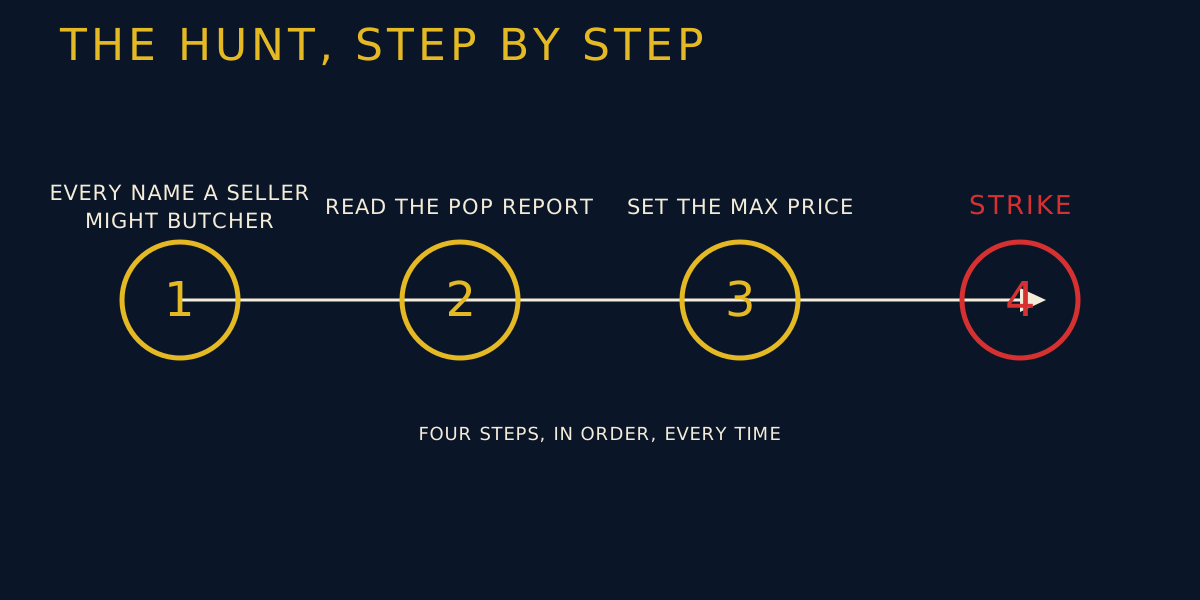
Do the pop report math before you fall in love
Every grading company publishes a population report. Pull it. Count how many copies exist at your grade or better. Sometimes that number is nine. Sometimes it is ninety. Both are real answers, and both change how you hunt.
Nine copies at PSA 10, and the arithmetic gets brutal fast. Most of those nine are already sitting in somebody's collection who is not selling. Some are locked in a set registry. A few are overseas. What is actually available to buy at any given moment might be one or two cards, full stop, and that is before anyone else in the hobby knows they want it too.
This is not a reason to quit. It is a reason to stop guessing and start counting. A target with 40 copies at your grade window behaves completely differently than a target with 4. Know which game you are playing before you spend a dollar.
Nine copies at PSA 10, worldwide. Most are already in a collection that is not selling. What's actually buyable at any moment might be one or two cards, full stop.
Saved searches, every way a seller might butcher the name
Set up the alert on every marketplace you use, and do not stop at the correct name. Sellers list cards wrong constantly, not out of malice, just out of not knowing the hobby's own jargon. Search the full name, the abbreviated name, common misspellings, the parallel name with and without the year, the card number with and without the pound sign. Try the player's nickname. Try the wrong sport tag, because it happens more than you would think.
The card you want might be sitting in an active listing right now, undiscovered by anyone searching the correct name, because the seller typed "chrome refractor rc" instead of the parallel's actual name. That listing is invisible to a lazy search and sitting in plain sight to a thorough one.
Auction alerts and the number you write down first
Set alerts on the completed auction platforms too, not just fixed listings. And before a single auction you are watching gets close to ending, write your max number down somewhere you will actually look at again. Not in your head. Written down.
Auctions are built to make you forget that number in the final ninety seconds. Somebody else bids, your pulse ticks up, and the number in your head starts drifting upward right along with it. The number on paper does not drift. It just sits there being honest with you when you are not being honest with yourself.
The group-post that works and the one that gets ignored
"Looking for 2023 Bowman Chrome Sepia Refractor #BCP-45, PSA 9+, will pay fair market plus a finder's fee" gets read and gets remembered. It is specific, it respects the time of whoever reads it, and it tells them exactly what to keep an eye out for on your behalf.
"Anyone got any good rookie parallels for sale?" gets scrolled past in half a second. Nobody can hold that in their head for the next three months while they are digging through boxes at a show. Specificity is the whole courtesy here. A vague ask is not a modest ask, it is just an ask nobody can actually act on.
The patience math nobody wants to hear
A true low-pop card at your exact grade might surface publicly a handful of times a year. Maybe less. If you are chasing something with real scarcity, plan in months, not days. Anyone telling you a genuinely rare card at a tight grade tolerance is a weekend project either has not done the pop report math or is about to sell you something that is not quite what you asked for.
The trap: settling because you are tired
This is the one that gets almost everybody eventually. Three months into a hunt, a similar card shows up. Same player, different parallel, one grade off from what you wanted. It is close. It is right there. And you are tired of looking.
Buy that card and you have not finished the hunt, you have quit it and called it something else. The target you wrote down at the start was the target for a reason. If it changes, change it on purpose, in a clear-headed moment, not at midnight after your fourth week of dead-end searches.
The honest part
This is genuinely a part-time job. Pop report math, saved searches across five sites, watching auctions, reading a room full of strangers on a forum, and doing it all with the discipline to not talk yourself into the wrong card. Most collectors do not have the hours for that on top of everything else in their life.
It happens to be our full-time job. That is what The Hunt is. $250 to start the search, and it counts toward the fee. The fee tiers with the card: 10% up to $5,000, 7% up to $15,000, 5% above that. Your deposit comes back if we come up empty. We do the pop report arithmetic, we run the searches under every name a seller might butcher, and we write the max price down before the auction starts. You just tell us the five lines.