
The 2026 Topps Chrome Baseball MVP Buyback sounds simple: hold the right cards, wait for the awards, trade them for credit. The part that gets collectors is the fine print. Not every Chrome card counts. A /100 and a /99 land in different value tiers. Cash is not an option. The clock does not start until the MVPs are announced.
Here is the clean version, based on Topps' official 2026 MLB MVP Buyback page.
The player matters first. The exact card category decides the credit.
The winners are not known yet
There will be two eligible players: the 2026 American League MVP and the 2026 National League MVP. MLB is expected to announce both awards in November 2026. Until then, every candidate card is still a bet on who wins.
The program begins shortly after those announcements. It ends January 31, 2027. A card of a player who finishes second does not qualify because he had a great year. The award winner is the trigger.
The four credit tiers
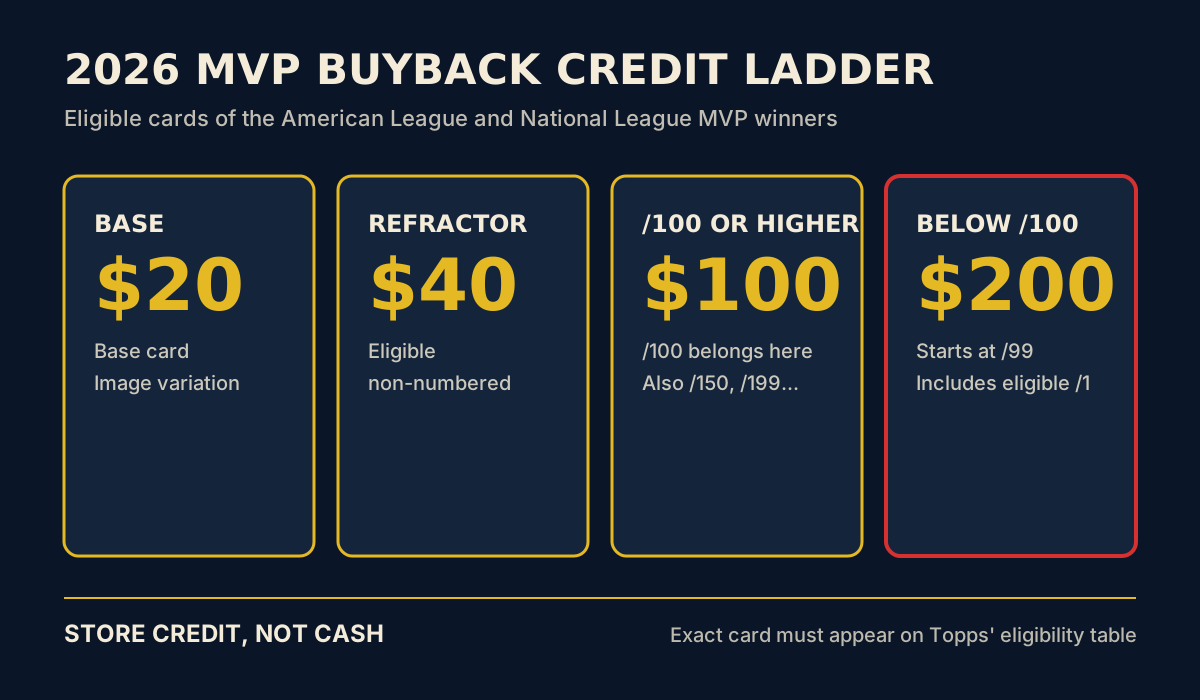
Topps sets the value by card type:
- $20: 2026 Topps Chrome base card or base image variation
- $40: eligible non-numbered refractor
- $100: eligible numbered parallel with a print run of /100 or higher
- $200: eligible numbered parallel with a print run below /100
That numbered boundary deserves a second look. A card numbered to 100 belongs in the $100 tier. A /99 belongs in the $200 tier. "Below 100" means /99, /75, /50, /30, /25, /10, /5, /2, /1, and the other eligible print runs under 100.
The payment is store credit, not cash. A participating local shop issues its own store credit. An authorized mail-in partner issues online credit for that retailer's account.
Which 2026 cards are eligible
The eligible pool starts with 2026 Topps Chrome Baseball base cards of the two MVP winners. Topps also includes base image variations and a defined group of refractors and numbered parallels.
The eligible non-numbered $40 group includes Refractor, X-Fractor, Prism, Red White and Blue, Baseball Seams, Topps, Raywave, Geometric, MLB Logofractor, and Wave Refractors.
The $100 group includes the eligible higher-print numbered cards. Topps lists Negative /400, Pink /250, MLB Logofractor Pink /250, MLB Logofractor Image Variation /200, Aqua /199 variants, Blue /150 variants, and the Lightboard Logo Variation in this tier.
The $200 group begins at /99. It includes eligible Green /99, Purple /75, Topps 75th Anniversary /75, Gold /50, White /30, Orange /25, Black /10, Red /5, Frozenfractor /5, Tie-Dye Geometric /2, Superfractor /1, Printing Plate /1, and Rose Gold MLB Logofractor /1 families. Image variations and the Wave, Raywave, Geometric, X-Fractor, and MLB Logofractor treatments count only where Topps lists that exact card on its eligibility table.
That last sentence is the safety check. Color alone is not enough. Before you trade or buy a card because of the program, match the exact card name and product to the official eligibility table.
The exception from 2025
The program is built around 2026 Topps Chrome, with one narrow prior-year exception. If Shohei Ohtani or Aaron Judge wins a second straight MVP in 2026, the eligible pool also includes that player's 2025 MVP Buyback cards that Topps stamped and reinserted.
An ordinary unstamped 2025 Chrome card does not qualify under that exception. The stamp and reinsertion are the point. Do not treat every 2025 Ohtani or Judge Chrome card as future buyback credit.
What does not count
Topps specifically excludes other 2026 Chrome products such as Chrome Black and Chrome Sapphire. It also excludes unstamped MVP Buyback cards from earlier years.
That means "Topps Chrome" on the front of a box is not enough. The card has to come from an eligible 2026 Topps Chrome Baseball product or fit the stamped 2025 back-to-back exception.
Autographs and inserts are not automatically eligible either. Use Topps' table, not the general look of the card, as the final check.
Condition is more forgiving than grading
The card does not need to be mint. Topps says a card can qualify as long as it is in one piece. Ripped or altered cards will not be accepted.
That does not mean condition is irrelevant before the winners are announced. A candidate card still has normal collector value today, and rough handling can damage that value if the player does not win. Sleeve it. Keep it flat. Do not mark it, trim it, or try to improve it.
Is there a redemption limit
Topps does not set an official card limit. Each participating hobby shop can decide how many cards it will accept. A shop cap is not a change to the published card values. It is a limit on how many cards that shop chooses to buy back.
If you have a large stack, call the shop before making the trip. Ask whether it is participating, whether it has a cap, and when it will begin accepting 2026 cards.
How to redeem in person
- Wait for the American League and National League MVP announcements in November 2026.
- Confirm that the player won and that each exact card appears in Topps' eligibility table.
- Find a participating shop through the locator on Topps' program page.
- Ask the shop about its start date and any card limit.
- Bring the eligible cards in and receive that shop's store credit.
Do not assume every card shop participates. The program runs through Topps-certified buyback shops.
How mail-in redemption works
Topps also names authorized mail-in partners for collectors who do not live near a participating shop. The official page currently says detailed 2026 MLB mail-in instructions will be posted once the program goes live.
The practical move is to wait for that form. Use the retailer named by Topps, create the required retailer account, follow that partner's packing and submission instructions, and keep tracking until the online credit appears. Do not mail cards to a retailer based on last year's address or form.
The collector math before November
The buyback value is not the same thing as today's market value. Before the awards, a candidate can lose, and the credit can go to zero. After an award, a scarce parallel can be worth more to a collector than the published store credit.
So use the program value as a floor you may be able to exercise, not an automatic sale price. For a base card, $20 in future store credit can be the whole thesis. For a /25 or /5, the buyback may be the least interesting reason to own it.
If this is your first buyback cycle, start with Demystifying the Buyback. If the prospect side of these programs is what pulled you in, our Bowman Red Rookie Redemption guide covers that separate program and its different rules.
The checklist to keep
- Two players qualify: the 2026 AL MVP and NL MVP.
- The program starts after the November announcements and ends January 31, 2027.
- Base and base image variations are $20 in store credit.
- Eligible non-numbered refractors are $40.
- Eligible numbered cards at /100 or higher are $100.
- Eligible numbered cards below /100 are $200.
- Credit is not cash.
- Chrome Black, Chrome Sapphire, and ordinary prior-year cards do not count.
- The 2025 exception applies only to stamped, reinserted Ohtani or Judge cards if that player wins back to back.
- Cards do not need to be mint, but ripped or altered cards are out.
- Topps has no official cap. Individual shops may set one.
- Match every card to the official table before you buy, trade, or redeem it.
The program is not hard once the categories are separated. Winner first. Exact card second. Credit tier third. Anything that skips one of those checks is how a shiny card turns into an awkward conversation at the counter.