
Somebody asks what their card is worth and points at a listing. Not a sold listing, an active one, some guy asking $400 for a card that has never once sold for $400. That is not a price. That is a wish with a Buy It Now button.
Comping is the discipline of ignoring what people ask and paying attention to what people actually paid. It sounds simple. It is simple. It is also the part of this hobby most people get wrong, including people who have been doing it for years. Here is the whole method, the way we run it on every price tag in the shop and every Case valuation.
Sold beats listed, always
Asking prices tell you what a seller hopes. Sold prices tell you what a buyer paid. Only one of those is a fact. A card can sit listed at $200 for eight months and never move, and that $200 number will still show up in price guides and group chats like it means something. It means somebody has not sold a card yet. That is all it means.
If you are pricing anything, the first move is to throw out every active listing and go find out what actually changed hands.
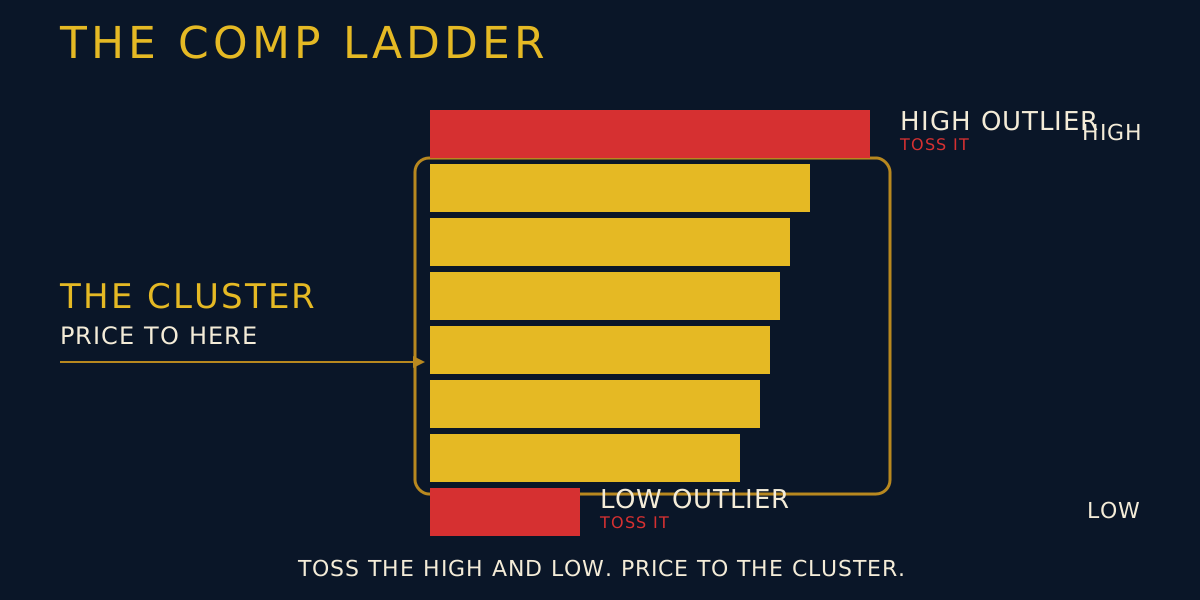
The last sale is not the price. The cluster is.
This is the mistake that trips up smart people. They find one sold comp and treat it like gospel. One data point is not a price, it is an anecdote with a dollar sign on it.
What you want is a cluster: five, eight, twelve sales close together in time and condition, sitting in a range. Maybe that range is $38 to $52. The price is not one number in that range, it is the shape of the range itself. If most of the sales sit around $44 with a couple of outliers on each side, $44 is your comp, not the $52 sale that happened to close last.
Trim the outliers, both directions
Two kinds of sales lie to you and they lie in opposite directions.
The desperation dump: somebody needed rent money, listed it to move fast, took the first offer. That sale is real, but it is not the market, it is one person's bad week.
The bidding war anomaly: two collectors who both needed that exact card for a set got into it in the last ten seconds of an auction and the price ran up 3x. Also real, also not the market. That is two people's grudge match.
Neither of those belongs in your cluster. You are not deleting them because they are inconvenient, you are deleting them because they describe a person, not a price.
Recency matters more than people think
A comp from six months ago can already be worthless, and not because the market drifted. Players get hurt, get traded, get benched, get a monster rookie season. A comp from before an injury is a comp for a different card. The cardboard did not change. The story attached to it did, and the story is most of the value.
Same goes the other direction. A cold prospect who broke out last month has old comps that are now insulting. Weight recent sales heavier than old ones, every time, and if the player's situation changed, throw out anything from before the change entirely.
Thin markets demand humility
Some cards do not trade enough to comp cleanly. Low-print parallels, obscure sets, guys nobody was chasing until last week. If you find three sales spread across six months, that is not a trend. That is three anecdotes wearing a trend's clothes.
The honest move on a thin market is to say the range is wide and say why. "Last three sales: $60, $110, $75, spread over five months" is a true sentence. Averaging those into a confident $82 and presenting it like a stock price is not honest, it is theater.
Raw and slabbed are not the same product
A raw card and a graded slab of the same card are different products being sold to different buyers for different reasons. Never comp one against the other. A raw sale tells you nothing firm about what a PSA 9 of that card goes for, because the buyer of a slab is paying for the label and the certainty, not just the cardboard.
PSA 9 and PSA 10 are not the same product either
This one should be obvious and somehow still isn't. A 9 and a 10 of the identical card can be a $40 gap or a $4,000 gap depending on the card, the pop report, and how badly people want the perfect copy. Comp within the grade. A stack of PSA 9 sales does not tell you what the 10 is worth, it tells you what the 9 is worth.
Parallel confusion: the number-one amateur mistake
This is the error we see more than any other. Somebody prices their gold parallel numbered to 50 using base refractor comps, because both cards have the same player, same set, same year, and the seller never noticed the little foil stamp that separates a $15 card from a $400 card.
Parallels are not flavor text. A base refractor, a gold /50, and a superfractor 1/1 are three separate markets that happen to share a photo. Comp the exact parallel, the exact print run, every time. If you cannot confirm the parallel on the comp you found, that comp does not count.
Where to actually look
eBay sold and completed listings, filtered to sold only, is the backbone of this. Cross-check on 130point, which aggregates eBay sold data and makes the cluster easier to see at a glance. For bigger cards, pull auction house archives (Goldin, PWCC, Heritage), since those sales skew toward higher-end cards.
A worked example
Say you are pricing a 2023 rookie autograph parallel numbered to 25. You pull eight sold comps in the last four months, all confirmed to that exact parallel and print run, in raw condition since none are graded. They land at $310, $340, $325, $290, $600, $315, $330, $305.
That $600 sale sticks out. You check it: it closed during a live-break hype window the week the player had a five-touchdown game. Real sale, not representative right now. Pull it.
What's left clusters tight around $290 to $340, center of mass around $315. That is your comp. Not $600, not the $290 floor, the center of a tight cluster with the noise removed and the reasoning written down.
Why we do it this way
This is exactly how every price tag in our shop and every valuation in the Case gets set. Sold comps, clustered, trimmed, weighted for recency, matched exact parallel and exact grade. No vibes, no asking prices dressed up as data.
And when the market genuinely will not give us a clean answer, thin comps, conflicting sales, no reliable cluster, we say so on the listing instead of making a number up. An honest "we don't have solid comps on this one" beats a confident price built on nothing.